



Rug Construction Guide: Tufted, Knotted & Woven | GetMyRugs

Rug Construction Guide: Tufted, Knotted, and Woven
Most people shop for a rug by color and pattern first, and there's nothing wrong with that. But at GetMyRugs, we'd argue construction deserves just as much attention, since it's the single biggest factor in how long a rug actually lasts, how it feels underfoot, and what it costs. This rugs guide walks through the three constructions you'll encounter most often, in plain terms, so you know exactly what you're buying.
Why Construction Matters More Than People Expect
Two rugs can look nearly identical in a photo and still be genuinely different products underneath. One might last five decades; the other might need replacing in ten years. One might cost three times as much as the other for reasons that have nothing to do with the pattern. Understanding construction is what lets you tell the difference before you buy, rather than discovering it later.
A simple trick works across almost every construction: flip the rug over. Hand-knotted rugs show their pattern mirrored clearly on the back, knot by knot. Hand-tufted rugs show a plain fabric or latex backing instead. Hand-woven rugs show the same flat structure on both sides, since there's no separate backing layer at all. That one check tells you more about genuine construction than almost anything else you could look for.
Hand-Knotted Rugs: The Heirloom Construction
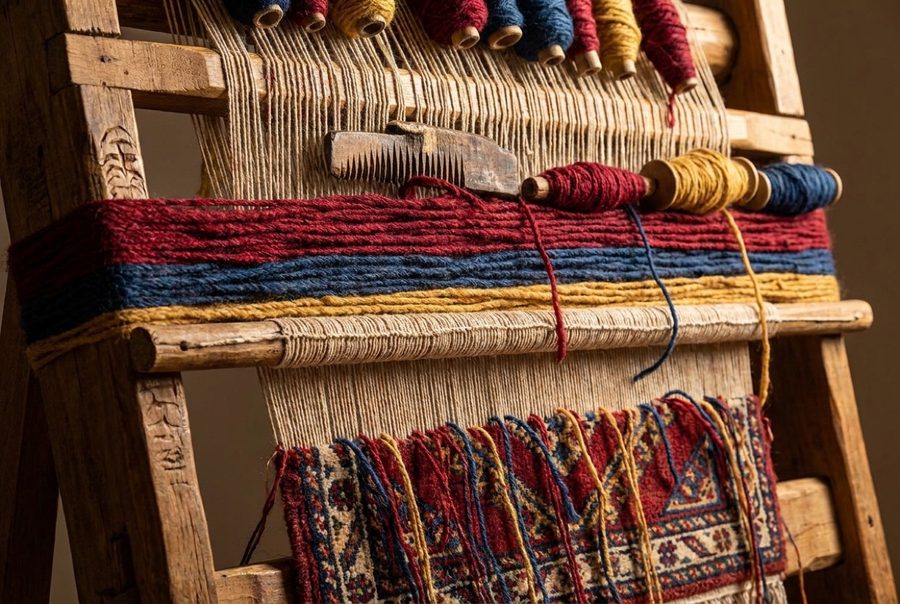
A hand-knotted rug is tied one knot at a time. A weaver sits at a loom and hand-ties each individual knot around the warp threads, sometimes reaching up to 100 knots per inch, building a pattern row by row over the course of months rather than days. There's no faster way to make one - a single rug can represent a skilled weaver's work for a significant stretch of time.
That density is why hand-knotted rugs routinely last 50 years or more. Because every knot is structurally locked into the rug's foundation, the pile can't shed loose or pull free the way it can with other constructions. This is the technique behind most fine traditional patterns - Persian, oriental, and other richly detailed designs - since the precision knotting genuinely benefits patterns with fine, curving detail. Hand knotted rugs remain the closest thing to a true heirloom in our entire catalog.
Hand-Tufted Rugs: Plush Comfort, Faster to Make
A hand-tufted rug is made differently. The design is sketched onto a stretched canvas, and an artisan uses a hand-held tufting tool to punch yarn through it, loop by loop, building up a dense, even pile. The back is then sealed with a fabric backing to hold everything in place. It's still genuine handwork - a skilled hand guides every line but it takes days rather than months.
That speed is exactly why hand-tufted rugs tend to cost meaningfully less than hand-knotted pieces at a similar size. The trade-off is durability: because tufts rely on backing rather than an anchored knot, a hand-tufted rug typically lasts 10 to 20 years with normal use rather than multiple decades. For a bedroom, a nursery, or a room you expect to redecorate within a decade or two, that timeline is honestly more than sufficient. Hand tufted rugs remain some of our most popular pieces for exactly this reason - genuine handmade comfort without the multi-month wait.
Hand-Woven Rugs: Flat, Light, and Reversible
A hand-woven rug takes a third approach entirely - yarn interlaced flat over a foundation, with no raised pile at all. This is the construction behind kilim and dhurrie-style designs, and it produces a genuinely different rug from the other two: lighter, lower-profile, and reversible, since flipping it over gives you a second usable surface once one side shows more wear.
Because there's no pile to trap dirt or crush under furniture, hand-woven rugs tend to be especially practical for kitchens, dining rooms, and busy hallways where easy care matters as much as looks. They also make excellent layering pieces, since their thin profile sits comfortably under a smaller accent rug without adding bulk. Hand woven rugs are also, quietly, some of the easiest pieces in our catalog to travel between rooms as your needs change, simply thanks to how light they are to lift and reposition.
Going Deeper: How These Rugs Are Actually Made
If you'd like to see the full process behind each construction from raw fiber to finished rug - our weaving techniques page walks through all six stages in detail, including how natural dyeing and hand-spinning fit into the picture before construction even begins. It's a genuinely useful read if you want to understand exactly what you're paying for.
Construction Also Changes How You Care for a Rug
The construction you choose affects more than the initial purchase - it shapes ongoing care too. Hand-knotted rugs benefit from professional cleaning every few years to keep the wool's natural oils intact. Hand-tufted rugs appreciate a rug pad to protect their backing from excess wear. Hand-woven rugs are the simplest to maintain, needing little beyond regular shaking or light vacuuming. Our full rug care guide breaks down the specific routine for each construction and material combination.
A Few Honest Questions We Hear Often
Is a more expensive construction always the "better" choice? Not necessarily - it depends entirely on the room. A hand-knotted rug is the right call for a formal living room you plan to keep for decades. A hand-tufted rug might genuinely be the smarter choice for a nursery you expect to redecorate in a few years. "Better" depends on how the room actually gets used, not just which construction costs more.
Can I tell hand-knotted from hand-tufted just by looking at the front of the rug? Sometimes, but not reliably. The front can look remarkably similar between the two constructions, especially in a photo. The flip-it-over test remains the most dependable way to check, regardless of how the front looks.
Does construction affect how a rug feels in different rooms, or is it purely about durability? Both, genuinely. A hand-knotted rug's firmer, more grounded feel suits a formal room; a hand-tufted rug's plush give suits a room built around comfort; a hand-woven rug's flat profile suits a busy, practical space. The right construction often matches the room's actual purpose as much as its expected lifespan.
It's also worth checking our current best-selling rugs on sale once you've settled on a construction - genuinely well-made pieces across all three techniques occasionally show up there at a friendlier price.
Buy With Confidence, Not Guesswork
Understanding construction turns rug shopping from a purely visual decision into an informed one. Whichever technique you land on, every rug we sell - hand-knotted, hand-tufted, or hand-woven - represents real, skilled handwork, not a shortcut dressed up to look like one.
Curious about materials, shapes, or specific rooms now that you understand construction? Our full library of rug guides covers all of it in more depth. And if you're still deciding which construction fits your space, our team is a message away - real people who can help you think it through before you buy, not after.
Keep reading
Find your perfect handmade rug
Over a thousand hand-knotted wool, silk and jute rugs — shipped free across the US, with free 30-day returns.
Shop all rugs